Quick heads up: This post may contain affiliate links to gear, hotels, flights, or experiences I’ve used or genuinely recommend. If you book through one, I may earn a commission at no extra cost to you. Full disclosure here.
Welli Hilli ski resort is a compact ski area in Gangwon Province, South Korea. This post covers what to expect when skiing Welli Hilli based on a first-hand visit in January 2026.
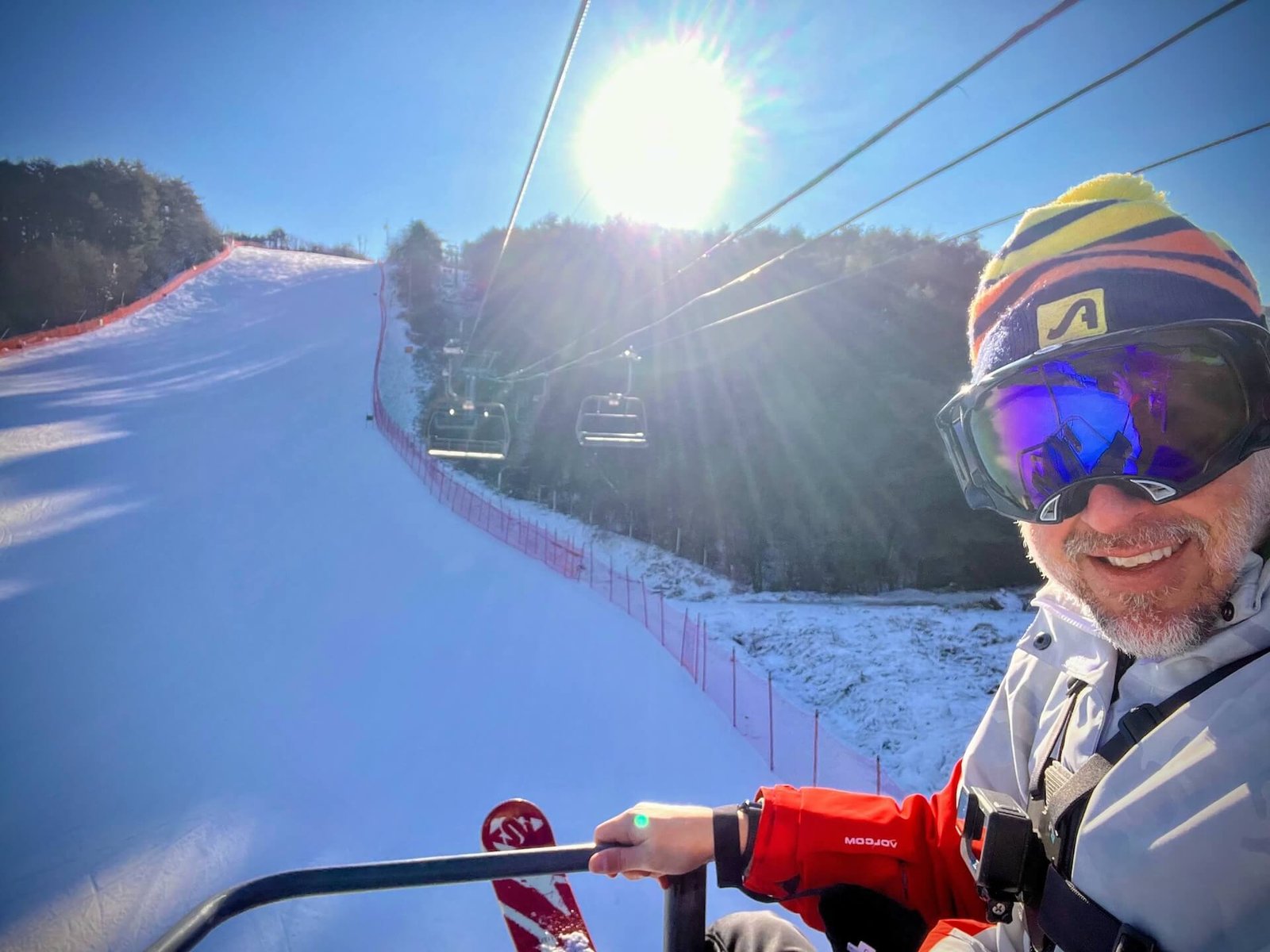
For the last several years, I’ve been driving past Welli Hilli Park Resort on my way to other Gangwon-do ski resorts and seasonal trips through the region. Every time I pass it, I catch the same view from the highway. Steep, white runs cutting straight down the mountain, clearly visible even from a distance.
And every time, I think the same thing. That actually looks like pretty good skiing. I also wondered why I rarely hear anyone talking about it, at least not among the skiers and snowboarders I know in South Korea. Each time I passed, I made a mental note to check it out before the snow melted for the season.
During the 2025–26 season, I finally acted on that thought and decided it was time to see if Welli Hilli was as good as it looked from the road. In January 2026, my wife and I booked a nearby dog-friendly pension and planned a weekday ski day to explore the mountain. Having lived and skied in South Korea for many years, I went in with realistic expectations.
Skiing in South Korea is mostly manmade snow, and it shouldn’t be confused with the powder reputation of Japan. With that in mind, Welli Hilli delivered what I had hoped to be true after years of driving past it. The ski area is on the small side, even by Korean standards, but the runs were well maintained, and the upper mountain offered some of the better steep, groomed terrain I’ve found in the country.
I grew up living and skiing in Vail, Colorado, but I’ve been living and skiing in South Korea for nearly 20 years. During that time, most of my ski days have been spent at Mona Yongpyong, High 1, and Muju Deogyusan, all of which I’ve written about in detail.
Welli Hilli now sits comfortably in my personal top three ski resorts in South Korea. It may be smaller than some of the better-known resorts, but it delivers on expert terrain, quality lifts, solid facilities, and relatively easy access.
📍 Where Is Welli Hilli Park Resort and How Easy Is It to Get There?
Welli Hilli is located in Dunnae-myeon, Hoengseong County, in Gangwon Province. It sits close enough to the main highway that it’s easy to spot as you pass, but not so deep into the mountains that getting there feels like a chore. Compared to many Korean ski resorts, its location is refreshingly straightforward.
If you’re coming from the southern part of the country, like I am from Daegu, it’s actually about 40 to 60 minutes closer than the resorts clustered around Pyeongchang, such as Yongpyong, Phoenix Park, and Alpensia. That makes a noticeable difference roundtrip, especially if you’re only planning a single day on the slopes.
From Seoul, the drive typically takes around two to two and a half hours, depending on traffic and road conditions. Most of the route is simple highway driving, which makes Welli Hilli easier to reach than resorts that require long mountain roads or more complicated final approaches.
One of Welli Hilli’s biggest advantages is KTX access. The nearest high-speed rail stop is Dunnae Station, which puts the resort within a short taxi or shuttle ride. That alone makes it stand out among Korean ski resorts, many of which are difficult to reach without a car. If you’re traveling from Seoul without your own vehicle, this is one of the more straightforward ski trips you can plan.
During the winter season, there are also organized shuttle buses and ski day trips departing from Seoul. These usually bundle transportation with lift tickets or rentals and are a convenient option if you want a low-effort plan.
👉 If coming from Seoul: Gangwon-do Welli Hilli Ski Resort One Day Tour
I personally drove from Daegu, which is what I usually do for ski trips since we often travel with our dog. Having a car opens up more lodging options in the surrounding area, including pensions and small hotels that aren’t right at the base. Between KTX access, shuttles, and private transfers, Welli Hilli is one of the more flexible ski resorts in South Korea when it comes to transportation.
This is also where private transfer options and bundled ski packages can make sense, depending on how you’re planning your trip.
🗺️ Mountain Layout and Terrain Flow at Welli Hilli
Welli Hilli is pretty straightforward. It’s essentially one main mountain that’s steep up top and much flatter down low. It’s fairly compact, especially compared to larger Korean resorts like Yongpyong or High 1, which are more spread out and offer more variety across different zones.
The upper part of the mountain is where you’ll find the steeper runs and the lifts that serve the resort’s expert and advanced skiing. From the top, several runs drop straight down the fall line, which makes it easy to lap without dealing with long traverses or awkward run-outs.
Lower on the mountain, the terrain opens up into wider, more forgiving runs. This is where most beginner and intermediate skiers tend to spend their time, and those areas naturally funnel toward the base. Crowds weren’t much of an issue up top during my visit, but the lower sections can back up in the way that’s typical at most Korean resorts, where the majority of skiers and snowboarders fall into the beginner to intermediate range.
One downside, at least from my perspective, is the lack of a true middle ground. If the advanced runs on the upper mountain feel like too much, the lower mountain runs may feel too easy.
Looking at the trail map below, the pink and orange runs are marked as advanced and intermediate, while the green runs are designated for beginners. From my perspective, the intermediate runs felt closer to advanced than true mid-level terrain, while the beginner runs were quite flat and clearly aimed at people just getting comfortable on skis or a board.
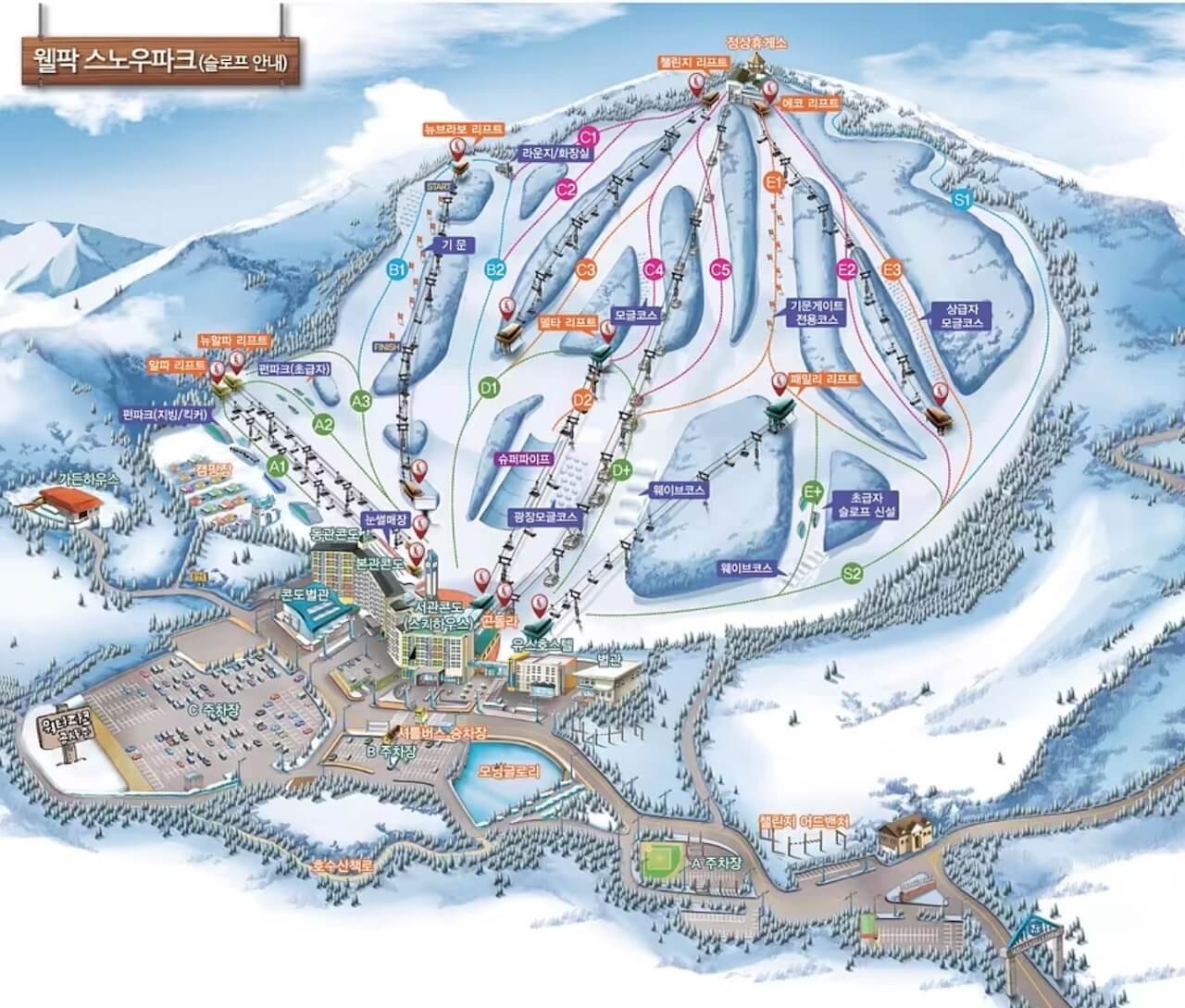
There aren’t a lot of lifts, but they’re laid out well. Once you figure out which lift serves the terrain you enjoy most, it’s easy to settle into a rhythm without constantly checking the map or threading through crowded junctions.
For a mountain that’s on the smaller side, Welli Hilli skis better than you might expect. Clear zones, logical lift placement, and simple top-to-bottom flow make it easy to focus on skiing rather than navigating.
⛷️ Upper Mountain Steeps and Overall Terrain at Welli Hilli
I spent most of my day skiing off the Challenge lift, which services the upper portion of the mountain and the best expert terrain. If you’re a strong skier or snowboarder, this is where you’ll likely want to spend your time. The pitches up top are noticeably steeper than anything lower down and feel long enough to stay interesting rather than over too quickly.
There’s also a gondola that reaches the same upper area from the base. It’s a convenient option, but I stuck to the chairlifts. I ski on powder skis, and dealing with longer, wider skis in a gondola can be more hassle than it’s worth, especially when lift lines are short. On the weekday I visited, the Challenge lift had almost no wait, so it made sense to just keep lapping it.
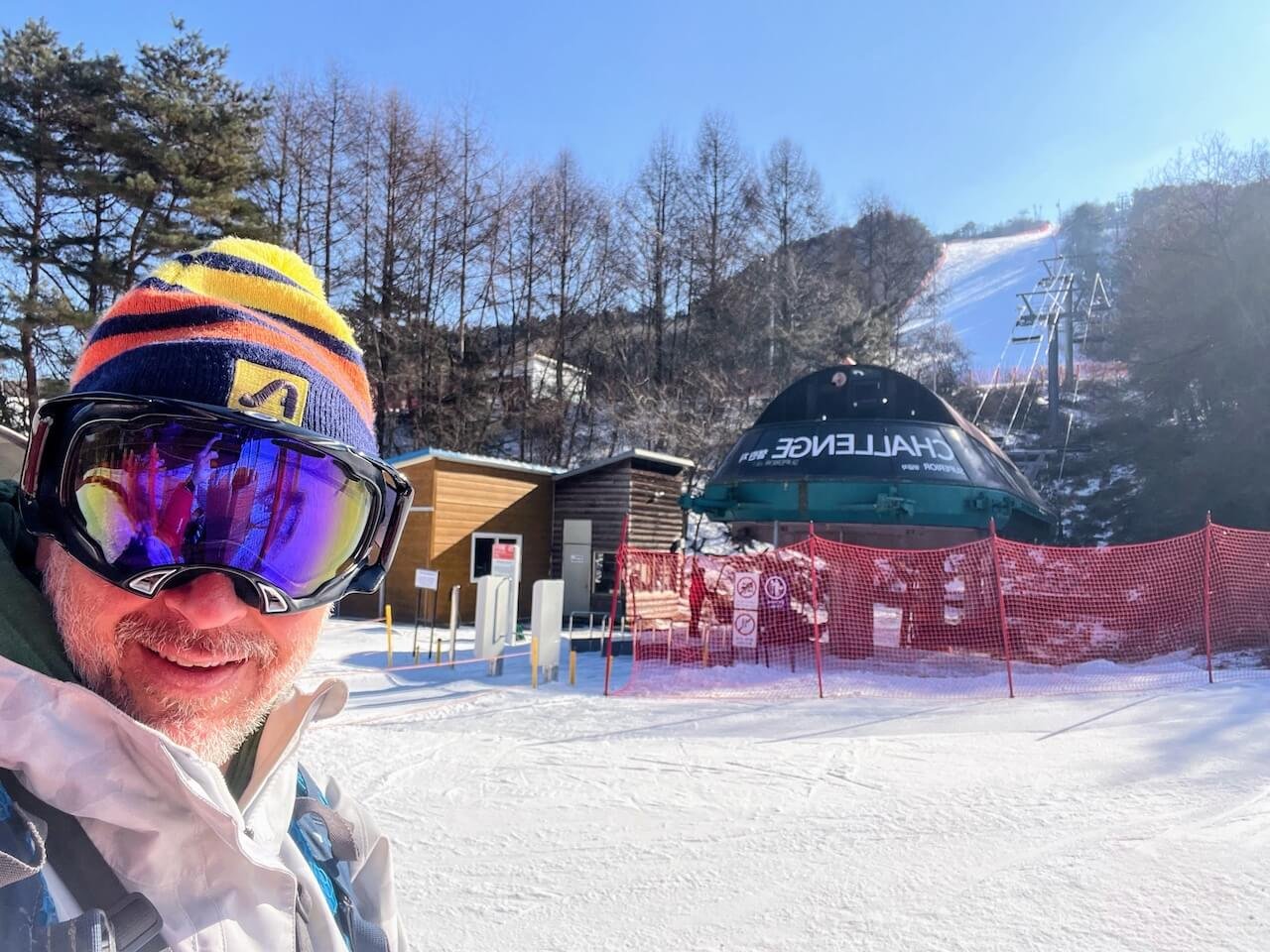
From the top of the Challenge lift, you’ve got a solid selection of steep, well-maintained runs to choose from. Most of my time was spent skiing down partway and hopping back on the Challenge lift to keep enjoying those upper pitches. You can mix things up a bit with different trail options, but the general theme stays the same: steep skiing up high, with plenty of room to open it up when it’s not crowded.
If you ski all the way down toward the gondola, the terrain flattens out quite a bit after the Challenge zone. It’s still enjoyable cruising, but it’s much mellower and feels more like a long run-out than a place you’d want to lap repeatedly if you’re focused on steeper terrain.
Crowds weren’t an issue on the upper mountain during my visit. While the lower beginner and intermediate areas were busier, the Challenge lift area stayed wide open. That separation made it easy to spend a few solid hours skiing without constant stops or waiting around in lift lines.
🎥 A Day Skiing Welli Hilli, From the Challenge Lift Down
👥 Crowds, Atmosphere and Overall Skiing Experience
My visit to Welli Hilli was about as relaxed as you could hope for at a Korean ski resort. I skied midweek during winter school vacation, but outside of a major holiday, and the mountain felt quiet overall. The expert terrain in particular was wide open.
The lower mountain was more congested, which is pretty typical in South Korea. Beginner and intermediate areas tend to draw ski school groups and families, and that was the case here as well. Even so, lift lines moved steadily during my visit, and the overall atmosphere stayed mellow.
From my experience skiing in Korea, weekends and holidays are a different story almost everywhere. Welli Hilli is smaller than places like High 1 or Yongpyong, so it’s reasonable to expect heavier congestion during peak periods, especially on the lower slopes. The gondola also allows foot passengers, which can add to lines when the resort is busy.
That said, Welli Hilli feels a bit less talked about than some of the bigger-name resorts. Whether that always translates to lighter crowds is hard to say, but with good timing, it can feel noticeably calmer than many other options.
🎟️ Lift Tickets, Passes and Ski Packages
Welli Hilli offers a range of lift ticket options based on how long you want to ski and when you visit. Like most ski resorts in South Korea, pricing is not as simple as full-day versus half-day passes. Instead, tickets are usually sold in time blocks, which gives you some flexibility without feeling like you are locked into an all-day commitment.
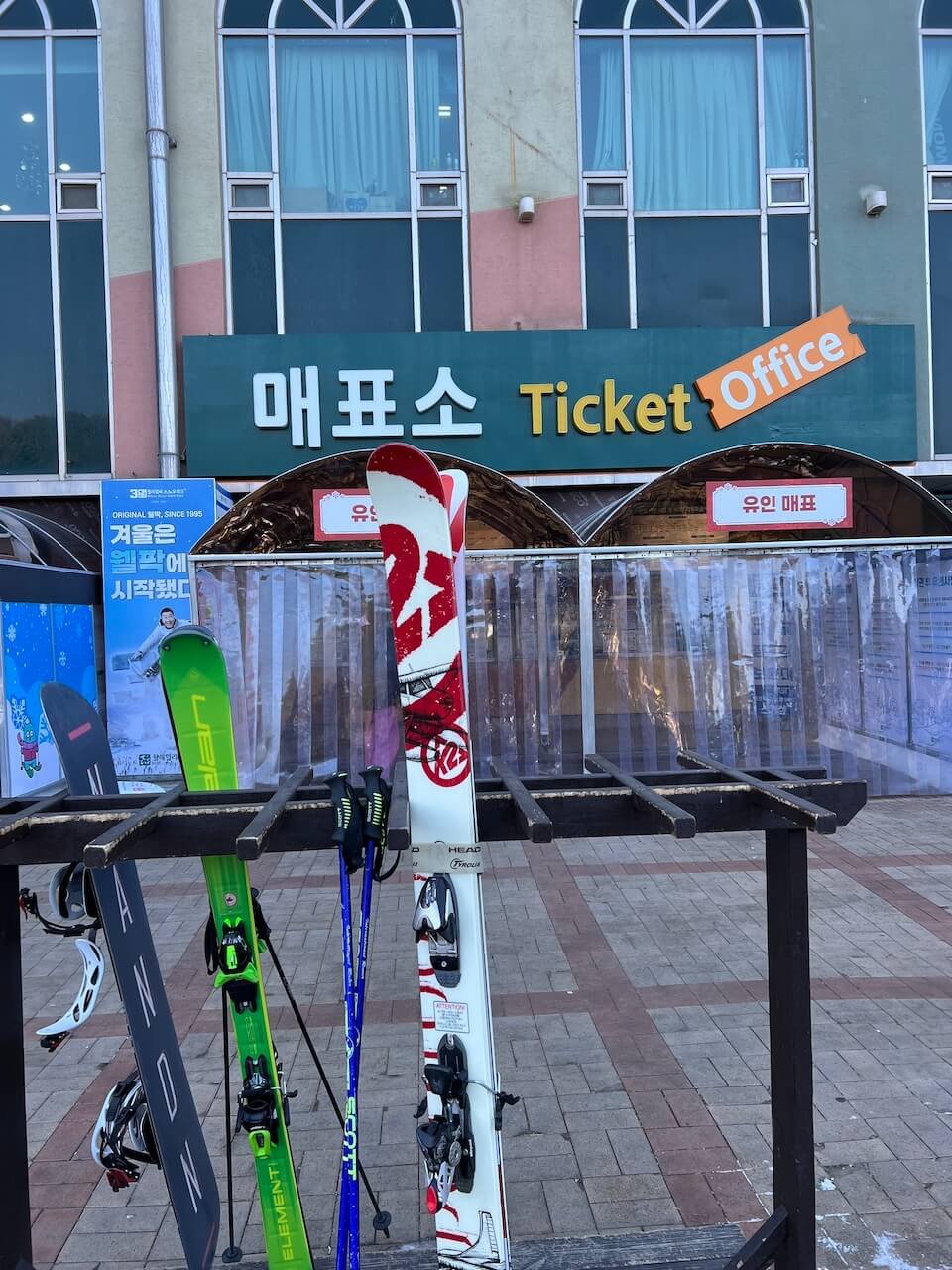
On my visit in January 2026, I paid around 52,000 KRW for a four-hour ticket. My wife purchased it through Naver, which is pretty typical if you have Korean language access. I spent most of that time skiing the upper mountain, and four hours was more than enough for the way I like to ski here.
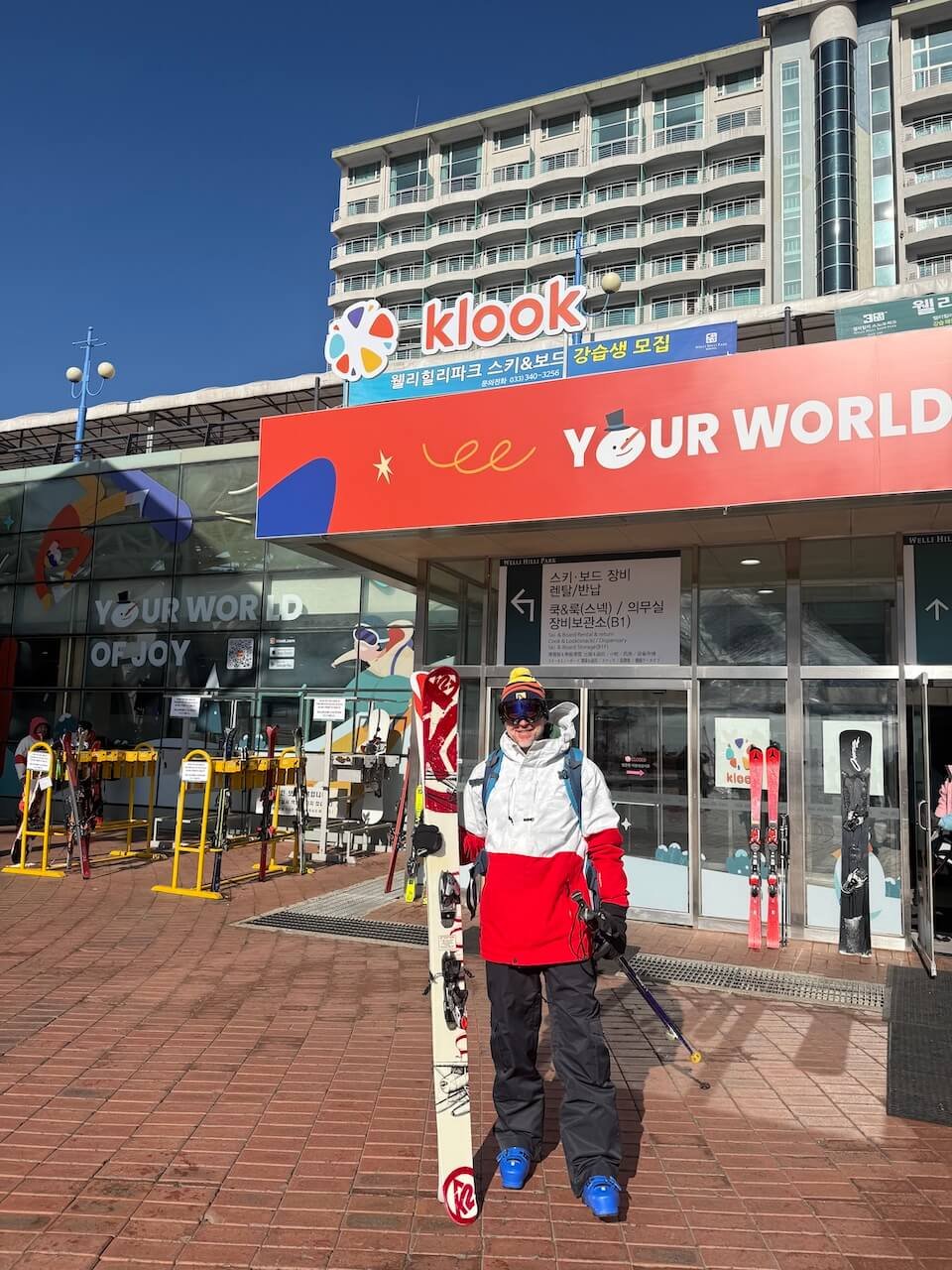
Finding clear, English-language lift ticket pricing online can be difficult. I tried to track it down while working on this post and didn’t have much luck. If you have a Korean friend who can help, that’s often the easiest route. If not, booking your tickets in English through Klook can simplify things quite a bit, especially if you’re also looking to bundle rentals or transportation.
Time-based tickets make sense at Welli Hilli, particularly if you’re planning a focused ski session rather than a full day on the mountain. Full-day and night skiing tickets are also available depending on the season and conditions.
There are also packaged options that bundle lift tickets with rentals, lessons, or round-trip transportation from Seoul. These are common and practical if you’re skiing without a car or visiting Korea for the first time.
🏨 Where to Stay at and Near Welli Hilli
If you want the simplest ski experience, staying right at the base of the mountain is the easiest option. Welli Hilli Park Resort has condo-style lodging directly at the ski area, with easy walking access to the lifts, rental shops, restaurants, and base facilities. If you’re planning to ski multiple sessions in a day or try night skiing, this is the most convenient setup.
Slopeside lodging makes things especially smooth on cold mornings or busy weekends. You can avoid driving, parking, and hauling gear back and forth, which can be a real advantage during peak season. This is also the most practical choice if you’re arriving by KTX and connecting by taxi or shuttle.
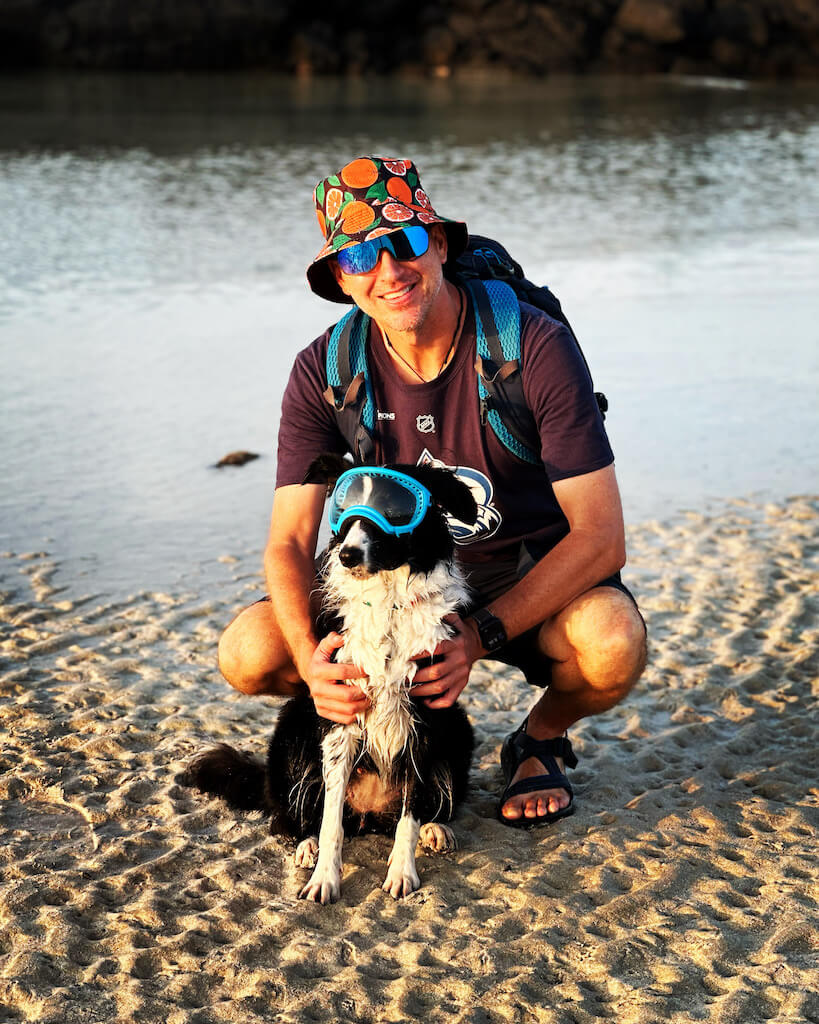
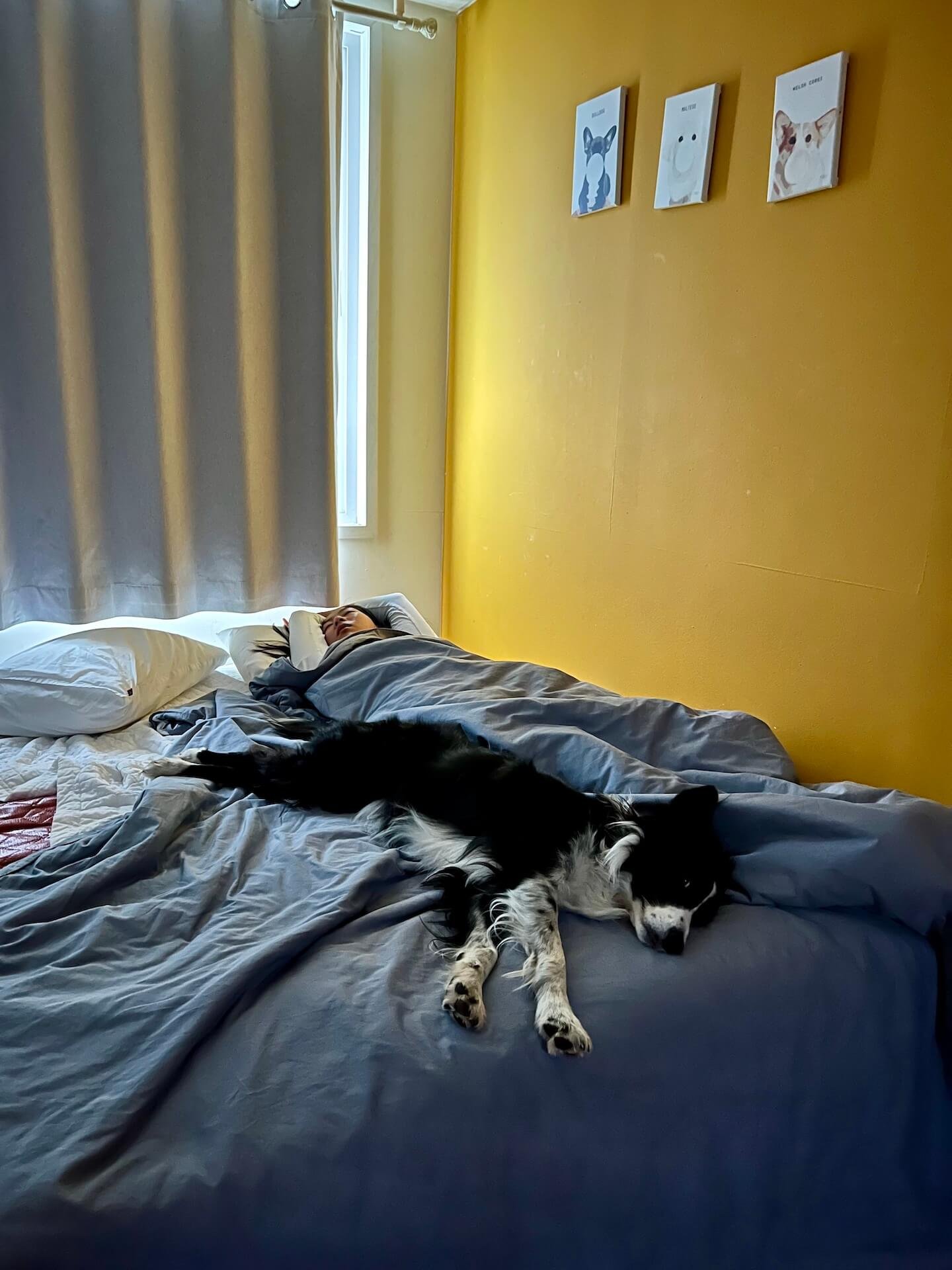
We chose to stay off-mountain at a dog-friendly pension called DogMily Pension, located a short drive from the resort. This worked well for us since we had a car and were traveling with our border collie. It was quiet, comfortable, and a nice place to unwind after skiing, but it’s not something I’d recommend without your own transportation, especially in winter.
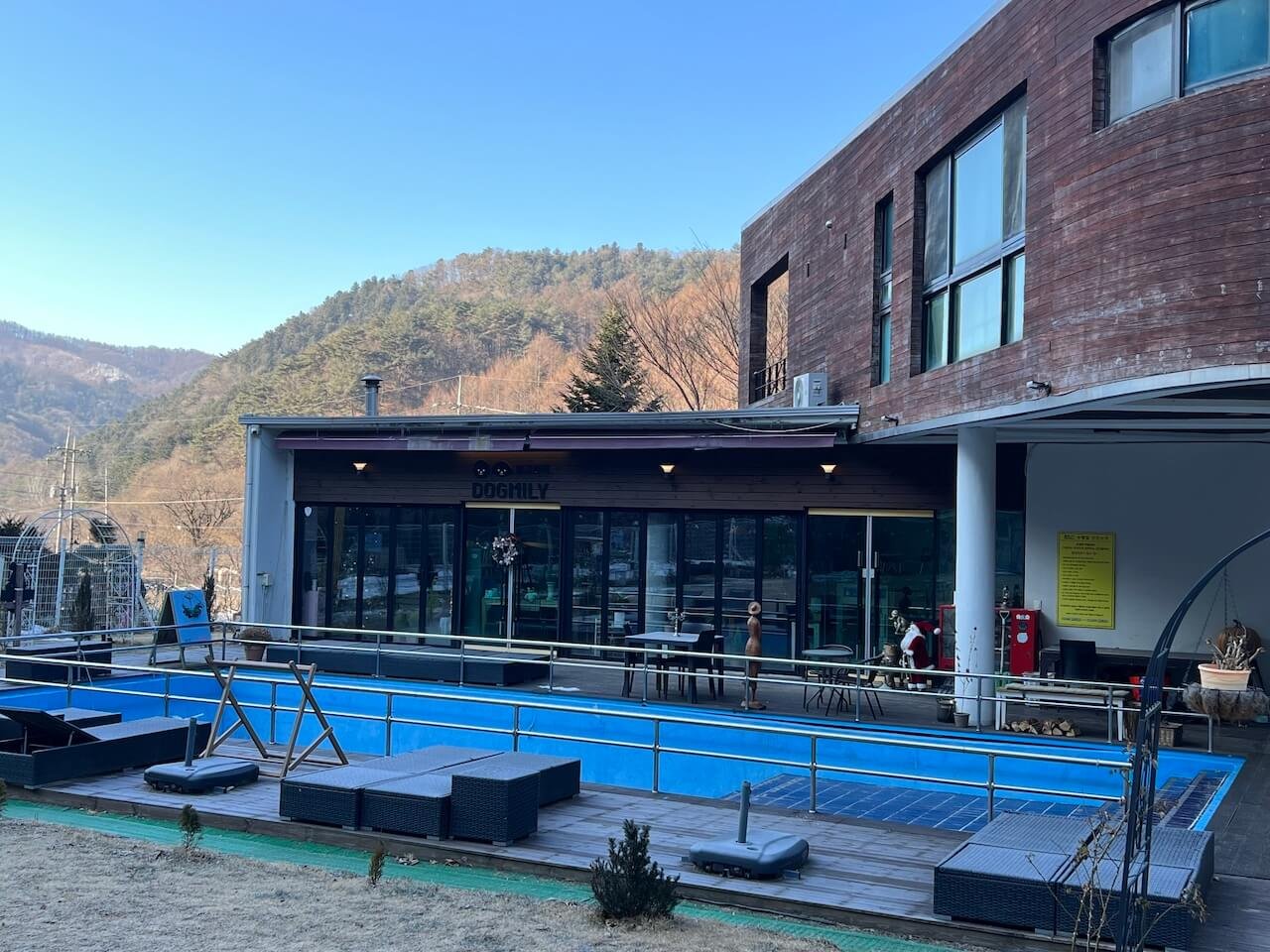
Beyond DogMily, there are quite a few pensions and small guesthouses scattered around the surrounding area. Many offer more space and a calmer atmosphere than the base-area lodging, and they can be a good fit if you prefer quieter evenings or are staying with pets.
Another option is staying in or near Hoengseong and treating Welli Hilli as a day-ski destination. This can make sense if you’re arriving by train, skiing for a single day, or looking for more budget-friendly accommodations. It does add a bit of driving or taxi time, but the distances are manageable.
🎿 Ski and Snowboard Rentals at Welli Hilli
Rental shops are located right at the base and are what most visitors use, especially if they’re coming on a day trip or booking a ski package. The on-site rentals cover the basics and are standard for Korean ski resorts. They’re functional, well maintained, and fine for beginners and casual skiers.
I didn’t rent gear on this trip since I brought my own skis over from Colorado. Based on what I saw, the rental process looked efficient and straightforward, and quite similar to all of the major Korean resort base operations.
If you have a car and want more flexibility, there are independent rental shops in nearby towns that often offer better gear or quieter pickup times. These are worth considering if you’re particular about equipment, but not essential for most visitors.
🌙 Night Skiing at Welli Hilli
Night skiing is a big part of ski culture in South Korea, and Welli Hilli participates in that tradition. Select runs are lit in the evening, usually on the lower and mid-mountain terrain, and the base area takes on a busier, more social atmosphere.
Night skiing isn’t really my thing unless I’m staying ski-in, ski-out. Since we stayed at an off-the-grid pension and drove in for a daytime session, it wasn’t part of the plan this time. After a few solid hours on the upper mountain, I was happy to call it a day.
For many skiers in Korea, though, night skiing is a highlight, especially for locals and students. I’ve included a short reference video below from a previous night skiing session at High 1 to give a sense of what it looks like.
🎥 Night Skiing in South Korea
❄️ Final Thoughts on Skiing Welli Hilli
I’m glad I finally stopped to ski Welli Hilli instead of just admiring it from the road. From Daegu, it’s about an hour closer than Yongpyong or High 1, which makes it much more appealing for a short trip.
The upper mountain was the highlight for me. Spending an afternoon lapping the Challenge lift was a lot of fun, and the steeper terrain stayed engaging the entire time. I was also impressed by the base area, facilities, and nearby town, all of which felt more developed than I had expected.
KTX access was another welcome discovery. If I didn’t have a car, that alone would make Welli Hilli a strong option. Easy rail access is rare among Korean ski resorts and lowers the barrier to visiting in a meaningful way.
The main limitation is size. Welli Hilli isn’t a large mountain, and I’m not sure I’d personally need to ski it for multiple consecutive days. Compared to Yongpyong or High 1, there’s less terrain to explore, especially for advanced skiers who like variety.
If you’re looking for a focused ski day with quality laps on steeper terrain, Welli Hilli is easy to recommend. I’ll almost certainly be back again next season, especially for another midweek visit.
❓ Frequently Asked Questions About Skiing Welli Hilli
Is Welli Hilli good for advanced or expert skiers?
Yes, especially on the upper mountain. The steepest and most engaging terrain is accessed via the Challenge lift, which is where I spent most of my time. The runs up top are noticeably steeper than the lower mountain and work well for doing repeated laps when it’s not crowded.
Is Welli Hilli suitable for beginners?
Yes, but mainly on the lower part of the mountain. The beginner and lower-intermediate runs are wide, groomed, and relatively flat, which makes them well suited for people just getting comfortable on skis or a snowboard. That said, there isn’t much overlap between beginner terrain and the steeper upper mountain.
How crowded does Welli Hilli get?
Crowds depend heavily on timing. I skied midweek outside of a major holiday and found the upper mountain wide open, with little waiting on the Challenge lift. Like most Korean resorts, the lower beginner and intermediate areas are busier, especially on weekends or during peak periods.
How do you get to Welli Hilli without a car?
Welli Hilli is one of the easier ski resorts in Korea to reach without driving. The nearest KTX stop is Dunnae Station, followed by a short taxi or shuttle ride. There are also ski day trips and package options from Seoul that include transportation.
Are lift tickets sold by the hour at Welli Hilli?
Tickets are sold in time blocks rather than strict hourly pricing. On my visit, I purchased a four-hour ticket, which worked well for a focused ski session. Full-day and night skiing tickets are also available depending on the season.
Is Welli Hilli worth visiting for more than one day?
That depends on what you’re looking for. For me, one solid day was enough, especially since the mountain is smaller than places like Yongpyong or High 1. If you’re content with a focused day of upper mountain laps or you’re a beginner who wants plenty of mellow terrain, it can still be a good choice.
👉 My complete guide to Yongpyong Resort: Expert Terrain, Lift Tickets, Rentals and Travel Tips
👉 My complete guide to High 1 Resort: Why I Keep Coming Back to This Mountain
👉 Skiing and Travel in Hokkaido, Japan
👉 Beyond Japow: My Search for the Next Great Ski Destination in Asia
🙏 Support the Blog
This post is not sponsored by any resort, hotel, or brand. Some of the links here are affiliate links, which means I may earn a small commission if you book through them at no extra cost to you.
If you found this guide helpful and want to support the time and travel that go into keeping this site running, you can send a small donation through Buy Me a Coffee using the button below.
It is never expected, but it genuinely helps me keep sharing honest advice and firsthand stories from my ski trips, hikes, and off the beaten path adventures around Asia.